I started meditating because I felt I was spending too much time thinking inside my head. Not long ago, as a complete beginner, I began sitting with Jon Kabat-Zinn’s MasterClass. I’ve already felt real benefits, and I want to keep it as a long-term habit. For other beginners, this is just a bit of my experience — I would genuinely recommend his course.
A tiny history of meditation
On the Indian subcontinent, contemplative practices go back thousands of years — dhyana, yogic inward attention. Buddhism systematized a lot of it (anapanasati, vipassana, and later Chan/Zen in China). Daoism, Christian contemplation, and Sufism each have their own versions of “quiet down and look at yourself.” In the second half of the twentieth century, it entered Western secular life at scale.
How to meditate
Kabat-Zinn puts it plainly: pay attention on purpose, in the present moment, non-judgmentally.
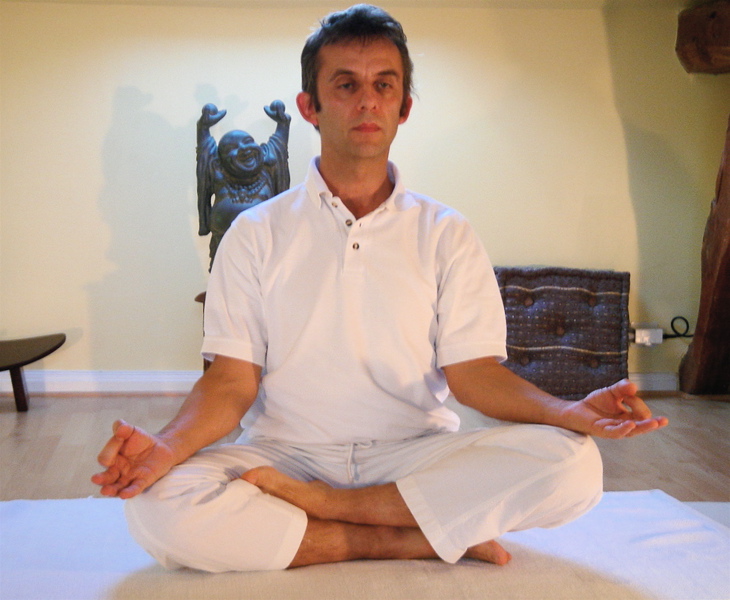
Posture, mudra, and setting don’t need to be fancy:
- Posture: Stable is enough. Full lotus is hard. Beginners can use easy pose (cross-legged), half-lotus, a chair, or a sofa — I often sit on the little sofa in my bedroom. Keep the spine naturally upright: not collapsed, not rigid. Soften the neck; tuck the chin a little. If your legs go numb, change position. Comfort first.
- Mudra: A common one is dhyāna mudrā — hands in the lap or just below the navel, palms up, right hand resting on left (some traditions reverse this), thumbs lightly touching. Skipping mudras is totally fine; hands on the knees works.
- Setting: Somewhere relatively quiet where you won’t be interrupted for a few tens of minutes. Soft light helps. You don’t need incense or a shrine setup — silencing your phone matters more than the ritual aesthetic.
The method itself is simple: sit, put attention on the breath — nose, chest, or belly — and stay with it for a few tens of minutes.
The most important piece is non-judging. When thoughts show up — “why am I anxious again,” “I wasted another day” — don’t pile on with “and now I’m judging again.” Thoughts and feelings are what you’re actually living through. They’re very, very normal. Make room for them, accept them, and they tend to pass on their own.
A few more mindfulness attitudes I want to share:
- There’s no special state, and no magic. What you’re doing is the meditation.
- Beginner’s mind. Treat each sit like the first: a little ritual, expectation, patience, curiosity.
- Keep it simple. When you’re uncomfortable, prioritize comfort. When it feels hard, make it easy.
- You’re already whole. The you sitting here is already complete.
- Don’t force it; don’t get too goal-hungry. The harder you chase “I must be calm,” the more you wrestle yourself.
Slowly you’ll feel a bit more calm and patience. When you do, give yourself a pat, then keep going.
Please stick with it patiently
As a kid I fantasized about meditation: sit down, enter some elevated special state, stand up a different person.
That’s the biggest myth. Meditation is feeling the life you’re already in — or, life itself is the practice. Thich Nhat Hanh puts this plainly: in The Miracle of Mindfulness, wash the dishes to wash the dishes, don’t rush toward tea; Peace Is Every Step also treats walking, eating, watering plants as the practice.
You can also think of it as fitness for the brain: you need a place, a time, and a little energy. It’s long-term, bit by bit. Give it enough patience and time.
Happier, and a bit sharper
My sense is that meditation mainly trains two modules: less mental self-warfare, and attention — which map pretty well onto what people call “happy” and “smart.”
First: accepting thoughts. When ideas and emotions arrive, let them sit. They’re already real for you; you don’t have to put them on trial. This rhymes with what I wrote about rumination / inner friction in the happiness post — it’s easy to fall into “why am I like this again,” looping tighter and tighter.
It also feels a bit like MBTI’s Se: stay in present-moment sensing instead of directing movies in your head. Just feel it — this is my life, this is me.
Second: training attention. At first, when you watch the breath, you’ll notice how fast the mind wanders. With practice, the stretch of focus gets a little longer. Right now everyone’s attention is getting stolen by feeds, social media, and short video — which makes this especially useful. Attention Is All You Need.
Neuroscientist Richard Davidson’s research suggests mindfulness training changes emotion-related circuits — for example amygdala responses and links to prefrontal areas — so it really does reshape the brain physically, and that takes weeks or longer. Here’s a systematic review.
And lots of successful people make time for it. Bridgewater’s Ray Dalio has said: “Whatever success I’ve had in life, has been more due to my meditating than anything else.” Yuval Noah Harari, who wrote Sapiens, practices vipassana about two hours a day. Steve Jobs also spent years with Zen. If they’re willing to spend the time — want to try?
A side note
If you like meditating, I’d also suggest reading a bit of philosophy of death — it can make you live more carefully. A good entry is Yale’s open course Shelly Kagan’s Death. For something deeper and more experiential, try Sogyal Rinpoche’s The Tibetan Book of Living and Dying(《西藏生死书》).
Further reading
- Jon Kabat-Zinn’s MasterClass; Wherever You Go, There You Are is an easy start
- Thich Nhat Hanh, The Miracle of Mindfulness; Peace Is Every Step
- Sogyal Rinpoche, The Tibetan Book of Living and Dying
- What actually makes humans happy
- Shelly Kagan, Death (Open Yale Courses)