Around age twelve I started asking myself, over and over: what is the meaning of life? After a long time I landed on an abstract answer — “happiness” — and I also saw how fundamentally selfish people are, as products of natural selection.
In middle school I read about Harvard’s decades-long happiness study. In the end, what mattered was the quality of relationships — partners, love, deep conversation. The finding is plain, but it matched my experience: what actually calmed me down was that stuff. Later I met the pop-science “four happy hormones” — dopamine, serotonin, oxytocin, endorphins. Tune them and you’re fine. It sounded crisp, like an instruction manual.
I had mild OCD and tried therapy, but because it wasn’t severe I didn’t stick with it. Later I encountered some Buddhist ideas: the core move is not to chase dopamine. That sat in an interesting tension with Western positive psychology’s “pursue happiness.”
In college I studied neuroscience and computer science. I started taking seriously a tension: I want to be happy and to do something meaningful for society. Those don’t always line up. AI looked like a good intersection — a technical field I’m strong in, and one that shapes society deeply.
I’ve also grown more aware of how large individual differences are. For my partner and me, work we find valuable and a sense of meaning seem to matter more than comfort alone. Many friends around us don’t think this way at all — and they’re doing fine. That gap is itself worth studying.
In the end life returns to daily routine. For me the things that sustain well-being are simple — sleep, exercise, walking with my partner, sometimes eating well and sometimes not, alternating work and rest, occasional travel. I run stressed — people call that high cortisol — and I tend toward seasonal depression, so I supplement magnesium and vitamin D.
“What makes people happy” sounds like a self-help shelf. But if you actually read what neuroscience, evolutionary psychology, and philosophy say, happiness turns out to be a strange thing — and pushing too hard for it can backfire.
The science of “happy hormones”
Start from the base: when you feel happy, chemistry is happening. Neuroscientists bundle four main “happy hormones” into D.O.S.E. — dopamine, oxytocin, serotonin, endorphins. Exercise, hugs, social life, even drugs — all of them trigger one or more of these. Dopamine has the richest story; it gets a lot of space below.
Dopamine is usually called the “reward chemical.” Cleveland Clinic and a thousand wellness blogs will tell you to raise it by finishing tasks, celebrating wins, eating chocolate. What they skip is that dopamine is far more than a pleasure signal. A 2026 Nature feature reports that neuroscientists are fundamentally rethinking dopamine’s role. Mark Humphries at the University of Nottingham put it bluntly: “the original model is no longer sufficient to explain all of this.” Better monitoring shows dopamine in attention, working memory, social behavior, threat responses, and movement — not just reward. The debate is heated enough that the Dopamine Society’s 2026 annual meeting in Seville scheduled a formal debate on replacing the dominant reward-prediction-error model.
Serotonin regulates mood, but roughly 90% of the body’s serotonin is made in the gut, not the brain. Alongside mood it shapes digestion, nausea, sleep, and pain. SSRIs — the most common antidepressants — increase serotonin availability, yet the serotonin hypothesis of depression has been seriously challenged. A 2022 umbrella review in Molecular Psychiatry found “no consistent evidence” that low serotonin causes depression. The molecule is doing something — just maybe not what we thought.
Oxytocin is the “love hormone,” released with touch, intimacy, and sex. It supports trust, attachment, and bonding. Recent work also ties it to neuroimmunity and stress — it can blunt inflammation and cognitive harm from sleep loss. But oxytocin isn’t universally prosocial: it strengthens in-group ties while increasing hostility toward out-groups. It is a love chemical and a tribalism chemical.
Endorphins are endogenous painkillers, released with hard exercise, stress, and pain. They drive the “runner’s high” and brief euphoria. Their evolutionary job isn’t happiness — it’s keeping you functional when you’re hurt so you can escape danger.
Beyond D.O.S.E., endocannabinoids — especially anandamide — deserve a mention. The name comes from Sanskrit ānanda, “bliss” — hence the “bliss molecule”. It isn’t a fifth happy hormone next to D.O.S.E.; it behaves more like an upstream modulator: CB1 activation triggers dopamine release, and blocking anandamide can block oxytocin’s effects. It also works unlike classic neurotransmitters — not mainly vesicular release down axons, but on-demand synthesis and retrograde signaling at synapses. The runner’s high was once pinned on endorphins; research now leans toward endocannabinoids as the main driver.
What strikes me is that these “happy hormones” are not independent — some actively oppose each other.
The clearest pair is dopamine and serotonin. A 2024 Nature paper found opponent control in the nucleus accumbens: when reward arrives, dopamine rises and serotonin falls together. Stanford’s coverage calls it “work in opposition to shape learning.” More specifically, in the striatum they regulate the same neurons in opposite directions — dopamine inhibits via D2 receptors; serotonin excites via 5HT2a/2c. Functionally, dopamine pushes approach; serotonin pushes wait / avoidance / patience. 2025 primate work backs the split: boosting dopamine promotes approach; boosting serotonin promotes avoidance.
In other words, your brain’s “go” and “steady” systems are wired to antagonize each other. You cannot be at maximum drive and maximum satiation — the wiring won’t allow it.
Another pair is oxytocin and cortisol (the stress hormone). A 2024 Frontiers in Endocrinology review frames them as “yin and yang” — opposed but interdependent. Oxytocin dampens the HPA axis through several pathways — anti-inflammatory, anxiolytic, analgesic. Cortisol mobilizes energy under stress; oxytocin pulls you back toward bonding and safety. Research finds that under sustained stress oxytocin rises first and cortisol follows about a week later — people with higher baseline oxytocin keep better mood and cognitive accuracy under pressure.
Endorphins and cortisol also push against each other. β-endorphin can suppress cortisol’s response to ACTH — a brake on the stress axis. But endorphins also stimulate dopamine and norepinephrine release. So the picture isn’t simple “relaxation” — you damp stress while activating another arousal system.
There is no single “happiness center.” Multiple competing systems run in parallel. Seeking thrills and seeking calm use antagonistic chemistry. Social bonding dampens stress responses — yet stress responses are what keep you alive in danger. Evolution did not optimize happiness; it optimized behavior that promoted survival across environments, even if you can never have all the good feelings at once.
The famous Harvard Study of Adult Development
The strongest finding in happiness research comes from the Harvard Study of Adult Development, running since 1938 — now 87 years, more than 2,500 participants across generations. As director Robert Waldinger puts it: the quality of your relationships is the best predictor of happiness and health — not career success, income, or cholesterol. Relationship satisfaction at 50 predicted health at 80 better than biological markers.
The pattern isn’t limited to romance. The study ties friendships, coworkers, community, even brief encounters with strangers to outcomes. More connected people live longer and stay physically healthier. Loneliness is as harmful as smoking half a pack a day or obesity.
Then money. The Easterlin paradox, documented since the 1970s and reconfirmed in 2025, says richer people are happier within a country, but national happiness does not rise steadily as countries get richer. A 2025 European study found that past a GDP threshold, non-material factors — cohesion, mental health, work-life balance — take over. A 2026 meta-review in the Journal of Happiness Studies found experiential and relational spending beats material purchases for lasting well-being.
So: relationships, community, meaning, challenging experiences — not novelty for its own sake, not wealth, not status. Decades of work agree. Yet when people guess what would make them happier, they still say money, career, or a better apartment.
The 2011 documentary Happy interviewed hundreds of people in 14 countries — from rickshaw drivers in Kolkata to Danish cohousing — and reached almost the same conclusion as Harvard.
The strange case of dopamine
Among the four hormones, dopamine has the richest story. Daniel Lieberman’s The Molecule of More claims it shapes love, sex, creativity, even human destiny. That sounds grand — until you read the papers.
The central insight in modern happiness neuroscience comes from Kent Berridge’s lab at Michigan: dopamine does not create pleasure. It creates wanting.
Berridge’s landmark work showed rats stripped of dopamine still liked sweetness normally — hedonic response unchanged. What they lost was the drive to seek it. They could starve beside food they enjoyed. Dopamine wasn’t making them feel good; it made them go get the thing. A 2025 Annual Review update confirms wanting/liking dissociation remains one of affective neuroscience’s most robust results. Nature Reviews Psychology (2025) mapped separate circuits — wanting through a broad mesolimbic dopamine web, liking through discrete hedonic hotspots.
The other classic finding is about when dopamine fires. In the 1990s, Wolfram Schultz recorded midbrain dopamine neurons in awake monkeys getting juice rewards. The cells did not simply track reward. They tracked reward prediction error — actual minus expected:
- Unexpected juice → dopamine burst
- After the monkey learned a cue predicted juice → the burst moved to the cue; the juice itself barely moved the neuron
- Cue appeared but juice was withheld → dopamine dipped below baseline at the expected time
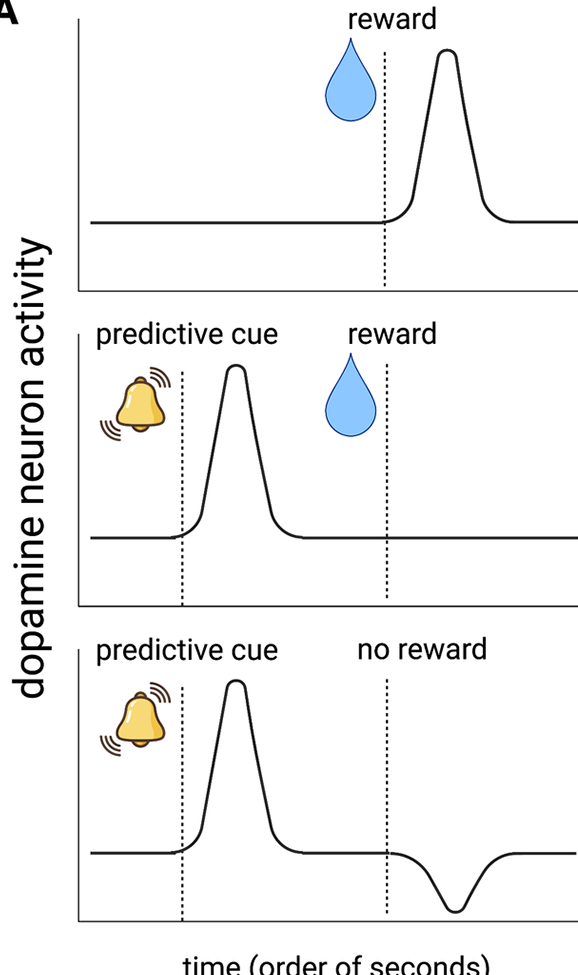
Figure: classic RPE pattern (panel A from Karin & Alon 2022, CC BY 4.0; schematic of Schultz et al.)
So dopamine is less a pleasure meter than a teaching signal that shapes learning and behavior. Fully expected rewards often add little dopamine; surprise does the work. That pattern is almost exactly the temporal-difference (TD) error used in reinforcement learning — which is why Schultz, Dayan, and Montague’s 1997 Science paper became a bridge between neuroscience and RL, not just a physiology result. (Schultz review, 2016)
This is not academic trivia. Your main motivational engine — goals, scrolling, novelty, achievement — is structurally disconnected from the system that feels good after you arrive. In a blunt neurological sense you are more a wanting machine than a happiness machine. Lieberman in The Molecule of More calls dopamine the “molecule of more” — not pleasure but restless appetite for future possibility. He splits chemistry into “upward” dopamine (novelty, goals, possibility) and “here and now” systems (serotonin, oxytocin, endorphins). Those classes naturally oppose each other — the same opponent logic as the 2024 Nature result.
It gets stranger. Oxford’s MRC Brain Network Dynamics Unit found positive prediction errors — things going better than expected — make people more risk-seeking afterward. A pleasant surprise spikes dopamine, engages “Go,” and suppresses “NoGo” risk processing. Happy people don’t get more cautious; they get more daring. A 2024 Frontiers in Behavioral Economics paper extends this outside the lab: elite athletes with higher life satisfaction also show higher risk tolerance.
That is the mechanism behind an evolutionary “happiness paradox.” When things go well — safe, fed, socially tied — your brain does not say sit and enjoy. It says explore. Take risks. Hunt novelty. From the brain’s view, satisfaction is wasted opportunity. If you are not under threat, this is the window to push boundaries and find new resources. Happiness does not breed contentment. It breeds restlessness.
Hedonic adaptation makes it worse. Neurobiology work maps habituation in the dopamine system — you need stronger or newer stimuli for the same hedonic kick. The reward system carries a built-in tolerance curve, like addiction. A 2024 dynamical model in the Journal of Happiness Studies shows two processes holding well-being near a set point, thermostat-like. You can spike above or below; the system pulls you back.
That is why lottery winners revert within months; why chronic pain patients often report normal life satisfaction after adaptation; why promotions, houses, and relationship milestones glow briefly then fade. The brain is not broken — it is doing what it was built to do. A permanently satisfied animal stops exploring, stops adapting, and loses the evolutionary game.
Work in Science Advances shows people get real hedonic value from anticipating rewards — mediated by hippocampus, dopamine midbrain, and ventromedial prefrontal cortex. Dopamine cells fire in expectation, not only at receipt, encoding expected pleasure. That is why people delay gratification and why vacations often peak in planning. Much dopamine comes from looking forward, not from the thing itself.
That ties straight to wanting versus liking. Wanting — dopamine — lights up in anticipation. Liking — hotspots — lights up in consumption. Wanting is louder and more distributed, so anticipation often feels stronger than the experience.
Counterintuitive truths about happiness
Put the literature together and happiness is not “more is better.” It ships with side effects and paradoxes.
Pursuing happiness makes you less happy. A study in Emotion found people primed to chase happiness felt less positive emotion — you manufacture a gap between expected and actual mood; the brain reads it as disappointment. 2025 work adds that the effort drains self-control. John Stuart Mill, a century ago: “Ask yourself whether you are happy, and you cease to be so.” That is a fundamental warning for any AI system trying to “optimize user happiness” — well-being is not a simple scalar to maximize.
Happiness dulls judgment. Decades of Forgas’s work shows happy people lean on heuristics, are easier to fool, keep more resources for themselves, and overestimate their ability. Sad people are more vigilant and accurate. Someone who feels only happiness is gullible, impulsive, scattered — bad for survival and for decisions. An AI environment that only feeds positive affect would systematically weaken users’ judgment.
Negative emotion is a feature, not a bug. Sadness improves memory accuracy. Anger boosts performance on hard tasks. Fear keeps you alive when danger is real. These are adaptive responses shaped by selection. A system — recommendation feed or utopia — that deletes all negative experience rips out the brain’s safety rails.
Difficulty builds the capacity for joy. The 2024 World Happiness Report found people who engage difficult emotions report ~40% higher life satisfaction than those who avoid them. Post-traumatic growth research shows people who face adversity actively improve on 15 of 17 well-being dimensions. Challenge is not only an obstacle to happiness — it is material for the skill of being happy. The logic matches what I argued in AI and human interaction design: when AI does the hard parts for you, your capacity to handle difficulty atrophies.
More choice, less happiness. Barry Schwartz’s paradox of choice: maximizers are more depressed, dissatisfied, and regretful than satisficers. AI gives us endless content, recommendations, possibilities. If Schwartz is right, that is not help — it is anxiety on tap.
The “sins” evolution installed
If you wanted stable long-term happiness, you would not build this. But you would not build for happiness. You would build for survival, reproduction, and exploration in an unpredictable world. Evolution did exactly that.
Which raises an uncomfortable follow-up: if the happiness system was not built for happiness, what about the rest of human nature? Are there traits that are innate, widespread, and — socially — genuinely harmful?
Neuroscience and evolutionary psychology both suggest yes. That matters for education, morality, and utopia.
Take envy. Culture treats it as a character flaw. Neuroscience mapped the circuit: medial prefrontal cortex routes others’ rewards to lateral hypothalamus, which adjusts how you value your own payoffs. When a peer wins, your brain literally discounts your own gains. The same circuit exists in baboons, pointing to deep evolutionary roots. Envy is not moral failure — it is resource-competition tracking for worlds where someone else’s food, territory, or mates meant less for you. A 2018 fMRI study shows others’ rewards activate regions that handle your own reward expectations.
Or take the “seven deadly sins” as a set. A 2024 Nature review of Guy Leschziner’s Seven Deadly Sins: The Biology of Being Human walks the neuroscience. Reward-linked sins — lust, greed, gluttony — light up nucleus accumbens and ventral striatum. Social sins — pride, envy — recruit medial PFC, self and comparison. Aggression engages dorsal ACC, conflict detection. These are not behaviors scratched onto a blank slate. They are operating-system features. The book asks: “If it’s hardwired, is it really a sin?”
Each maps to a survival function. Greed stockpiles in scarcity. Lust drives reproduction. Anger enables defense. Sloth saves energy. Gluttony banks calories before famine. Pride stabilizes dominance. Even the Dark Triad shows evolutionary upside: a 2025 study links psychopathy to more offspring and earlier first birth. Psychopaths are not evolutionary mistakes — a strategy that works, at least genetically, at least sometimes.
The Hobbes–Rousseau fight — brutish or good by nature — is a false binary. Evidence supports both. Infants show empathy and fairness within the first year. Children also hoard, exclude, and hit. Dawkins in 1976: genes are “selfish” replicators, yet the selfish machine yields cooperation and competition depending on context. Kin selection, reciprocity, dominance — one organism, many modes.
What is education doing? In neural terms, strengthening prefrontal brakes on the limbic system. “Moral development” — Kohlberg, Freud’s superego, parents saying “raise them right” — is largely building inhibitory circuits when adaptive impulse clashes with the group. The brain has built-in conflict architecture: resisting temptation recruits PFC to damp striatal and amygdala reward-seeking. Self-control is not absence of selfish impulse — it is a second system fighting the first.
Pop narratives — “be yourself,” “follow your urges,” “express your authentic self” — are dangerously incomplete. Part of you is prosocial: empathy, bonding, fairness. Part is antisocial: envy, dominance, in-group favoritism, hoarding. “Being yourself” without civilization’s overlay of education and norms means letting both systems run raw. Every culture has built institutions — religion, law, schools, norms — to channel the destructive and keep the constructive.
This ties back to happiness. Traits installed for individual survival — selfishness, envy, status races, risk-taking when comfortable — corrode the conditions Harvard says predict happiness. The Easterlin pattern says collective wealth need not lift collective mood; status competition moves the reference point so nobody feels ahead. The happiness system and the survival system have always been at odds.
Competition, comparison, and involution
A lot of people already have plenty — until they measure themselves against others, then mood drops, worry starts, and the future feels anxious.
In the US, the yardstick is often material and visible success — house, car, school, the life you can post. One stable finding: stronger materialistic values track lower subjective well-being (Kasser’s line of work). Cross-national data keep showing that income rank predicts well-being better than absolute wage. Another $10k matters less than watching peers clear $20k more. Social feeds make “other people you can see” run 24/7 — comparison stops being a handful of villagers and becomes an infinite scroll of age-mates.
In China, many name the same engine neijuan (内卷 / involution): everyone escalates effort, aggregate outcomes barely improve, individuals get more tired and anxious. In college samples, passive involution — having to race because everyone else is — correlates with anxiety; perceived involution climate intertwines with subjective well-being. The arenas are often exams, credentials, iron-rice-bowl jobs, big tech — rank and safety, not lifestyle display. When even basic rest and downtime feel impossible, people reach for tangping (躺平, “lying flat”) and bailan (摆烂, “let it rot”).
In the middle sits middle-class dread: fear of falling behind relatively, and of falling out absolutely. Analyses of middle-class anxiety call status anxiety the static peer ranking (who is “enough” among your cohort) and fear of downward mobility the dynamic dread (you or your kids slipping a rung). So the middle need not be “the least happy” on surveys — it is just especially stuck at “fine, but never enough”: you can see the top, and you have something to lose.
When ignorance helps
Uncomfortable question: if thinking more correlates with feeling worse, are people who do not think about it smarter?
My old gut model treated thinking and happiness as a shared uphill climb — overall ascending, with dips and local maxima along the way: peaks that feel highest from where you stand, but are not the global top.
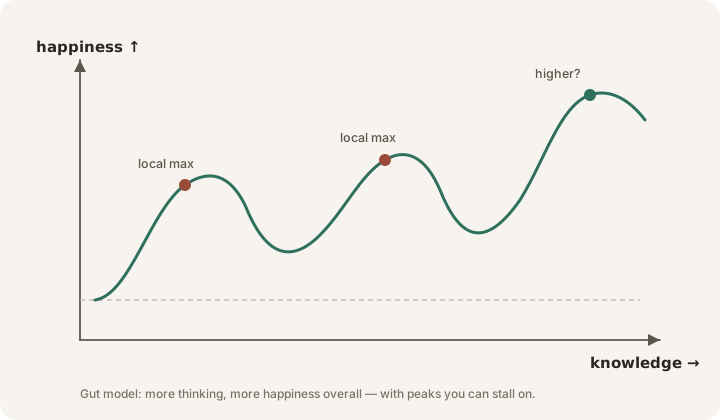
Figure: knowledge →, happiness ↑ — the gut model is an uphill climb with local maxima you can stall on.
Lived experience pushed back. The more I thought about some things, the less “meaning” there seemed to be — at least inside one human lifetime. Offer me the red pill or the blue pill from The Matrix, and I’d take blue: stay with pleasure. If we take seriously that living is largely for being happy, that looks like the rational move.
What does psychology say? The data are subtle. A nationally representative study in China found only a tiny, non-significant link between cognitive ability and happiness. Smarter people have objective advantages in income, health, status — not in subjective well-being. One reason: higher ability predicts underrating your relative socioeconomic position and being less confident about the future. More knowledge means more comparison targets — and comparison is happiness’s enemy.
Psychology splits introspection into self-reflection and rumination (what people now often call inner friction / mental self-drain). Research shows reflection can help; rumination clearly predicts lower well-being. The difference: reflection asks what something means; rumination asks why it happened to me — same cognitive horsepower, opposite outcomes. Higher ability can make ruminative loops more intricate and harder to escape.
People also choose not to know. 2025 Psychological Science findings summarized here finds adults strategically avoid information — bank balances, partner fidelity, cheaper prices after purchase — not from lack of curiosity but to protect mood. Children want everything explained; adults learn strategic ignorance. The “blissful ignorance effect”: after a decision, vague information feels better than detail because ambiguity leaves room to imagine the best case.
This lines up with “pursuing happiness makes you unhappy.” Chasing happiness is a kind of over-monitoring — you constantly measure the gap between felt state and ideal. People who do not chase lack that gap. People who do not know a better option escape the paradox of choice. People who never learned dopamine neuroscience do not mutter “this is just chemistry” in the middle of joy.
I am not saying ignorance is virtue. If you read this far, you cannot unlearn it. But the default — “more information always helps” — fails in domains of personal happiness: more data and deeper self-scrutiny often make life harder, not easier. Maybe happiness is less a problem to solve and more a state you stop forcing.
Individual differences
Everything above is species-level hardware. Individual variation is large enough that “what makes people happy” is almost the wrong question. Better: what makes this person happy?
Minnesota twin work attributes ~50% of happiness differences to genetics. Lykken and Tellegen humbly showed SES, education, income, marriage, and religion together explain only ~3% of variance. Set point is largely inherited, like height. Dopamine receptor density varies between people — fewer receptors mean you need more stimulation for the same reward response. Some people are content with routine; others stay restless — not willpower, hardware. A meta-analysis of 334,000 people finds low neuroticism, high extraversion, and high conscientiousness predict well-being best; neuroticism is 40–60% heritable. Some personality profiles fit happiness more easily. That is not fatalism — but not a level starting line either.
People also differ in what happiness means to them. A 2025 Journal of Happiness Studies paper sorts people into skeptics (happiness as fragile and external — lowest well-being), pleasure seekers (seize the moment), and growth seekers (meaning, growth, self-actualization — highest well-being). They are not picking tactics — they conceive happiness differently. Tilburg work plus recent imaging shows hedonic versus eudaimonic motives run different psychological pathways and produce different well-being profiles. Pleasure focus predicts better short-term mood; meaning focus predicts longer-run satisfaction. Both work — for different people.
That matches what I see. For my partner and me, meaningful work matters more than comfort. Many friends never think this way and are fine. I used to call it “depth of reflection”; now I read it as architecture and orientation. No moral score — just difference.
Culture rewrites the definition. Research across 63 countries shows North American happiness skews toward achievement and high-arousal joy; East Asia stresses harmony and social embeddedness. Individualism can harm well-being in collectivist settings. Much Western positive psychology — “find your passion,” maximize achievement — is culturally specific advice dressed as universal truth.
Can you move the set point? Yes — at a cost. Davidson’s work on Tibetan monks with 10,000+ hours of meditation shows large structural brain changes. That is thousands of hours of practice, not a weekend retreat.
Implications for utopia or AI: there is no single recipe for everyone’s happiness. Pleasure seekers and growth seekers need different environments. People at different points on the dopamine-receptor spectrum need different stimulation. Strategies that work in East Asia may backfire in North America. Any system — recommender or social policy — that assumes one happiness objective function is wrong at the root.
(Anti)utopia
I have always liked dystopian fiction and thought experiments like brains in vats. If the vat were engineered well — not crude dopamine flooding (we saw why that fails) but rich enough that life feels meaningful — why refuse?
Philosophers saw this early. Aristotle split hedonia from eudaimonia — pleasure versus flourishing and purpose. The good life is not the pleasant life but the active life. Modern work operationalizes the split with different neural substrates; imaging shows teens whose brains respond more to meaning than to pleasure are less depression-prone. Robert Nozick’s 1974 experience machine goes further: a device that makes you believe you are writing a great novel, falling in love, climbing mountains. Plug in? Most say no. Nozick argued we care about actually doing things, becoming a certain kind of person, and contact with real reality. In Berridge’s terms: liking can be stimulated directly; wanting needs engagement with the world. Meaning arises when both systems couple in real situations.
Here I part from many philosophers. If the vat is good enough — not only hotspots for liking but a working wanting system with real challenge, failure, growth, relationships — what functionally differs from “real” life? If subjective experience is identical, does “real” become an empty label? If you cannot tell and you are happy inside, is that not real enough?
On Bostrom’s simulation argument, we might already be inside one. AI makes these questions engineering, not only philosophy — utopia and dystopia both feel buildable.
Even setting the philosophy aside, the real world already faces huge problems. Nick Bostrom’s 2024 Deep Utopia asks a sharper version: what happens when superintelligent AI solves every practical problem — not only poverty and disease but all challenges. A world where anything you might try, a machine does better.
He calls this “post-instrumentality” — and argues it may be the hardest philosophical problem we face. Traditional meaning sources — survival, contribution, achievement — collapse when nothing you do is necessary. As Scott Alexander noted, Bostrom takes seriously that wireheading — direct stimulation of pleasure centers — need not be objectively meaningless; experiences could be profound — joy, ecstasy, deep significance. He even floats “wireheaded meaning.” The neuroethical core: if meaning can be manufactured, what separates authentic flourishing from counterfeit satisfaction?
What would you choose?
Sources: Every substantive claim links inline above. Key references: Harvard Study of Adult Development · Nature: “Dopamine takes a hit” (2026) · Berridge: wanting vs. liking (2025 Annual Review) · Schultz, Dayan & Montague: prediction and reward (Science 1997) · Schultz: dopamine RPE coding (2016) · Nature Reviews Psychology: wanting/liking circuits (2025) · Oxford: prediction errors → risk-seeking · Easterlin paradox revisited (2025) · Hedonic treadmill dynamical model (2024) · Nozick’s experience machine · Bostrom, Deep Utopia (2024) · Eudaimonia vs. hedonia taxonomy · PennNeuroKnow: D.O.S.E. complexity (2026) · Serotonin hypothesis challenged (2022) · Paradox of pursuing happiness (Emotion) · Pursuing happiness depletes self-control (2025) · Forgas: mood and cognition · Happiness and selfishness · Trait positive affect and empathy gap (PLOS ONE) · Upside of negative mood (Current Directions) · Anger improves task performance (APA) · Anticipatory pleasure (Science Advances) · Parenthood happiness paradox · Paradox of choice (Schwartz) · Happiness U-curve across 145 countries · Happiness heritability (Lykken & Tellegen) · Post-traumatic growth in 9/11 survivors · Generosity and happiness (Nature Communications) · Prosocial spending and happiness · Joy → overconfidence (PLOS ONE) · Positive affect and overconfidence (San Francisco Fed) · “Bliss is ignorance” — happiness and exploitation (OBHDP) · Winning streaks, confidence, and betting (PMC) · Pathological choice: neuroscience of gambling · DRD4 novelty-seeking polymorphism (Nature Genetics) · DRD4 and migration out of Africa · Abnormal reward system in mania · Envy circuit: MPFC → hypothalamus in macaques (Nature Communications) · Social comparison in baboons · Nature: “Is it really a sin if it’s hardwired?” (2024) · Neuroscience of the seven deadly sins · Dark triad traits and fertility (Frontiers, 2025) · The Selfish Gene — cooperation and competition · Davidson: affective style and well-being · Prefrontal asymmetry and emotion · Dopamine receptors inversely related to novelty-seeking · Big Five and well-being meta-analysis (334,567 participants) · Caudate volume predicts future well-being · Seven brain networks supporting well-being (2025) · Neural contributors to trauma resilience · Cultural differences in happiness across 63 countries · Female happiness paradox (2024) · Meditation and neuroplasticity