Work in progress. A list of questions, not answers. I’ll fill in as I read.
At twelve I kept asking what the meaning of life was. I landed on something abstract—happiness—and noticed people seem basically self-interested, as if shaped by natural evolution. The question didn’t go away. It got bigger.
At twenty-four the same question changed scale: Does the universe have any ultimate meaning? Or does life—on Earth, elsewhere, intelligences we build—repeat some macroscopic pattern, aim at some goal, or neither: only local order and a thermodynamic bill?
My current guess: the universe has no meaning, and because of the speed-of-light limit everything is local.
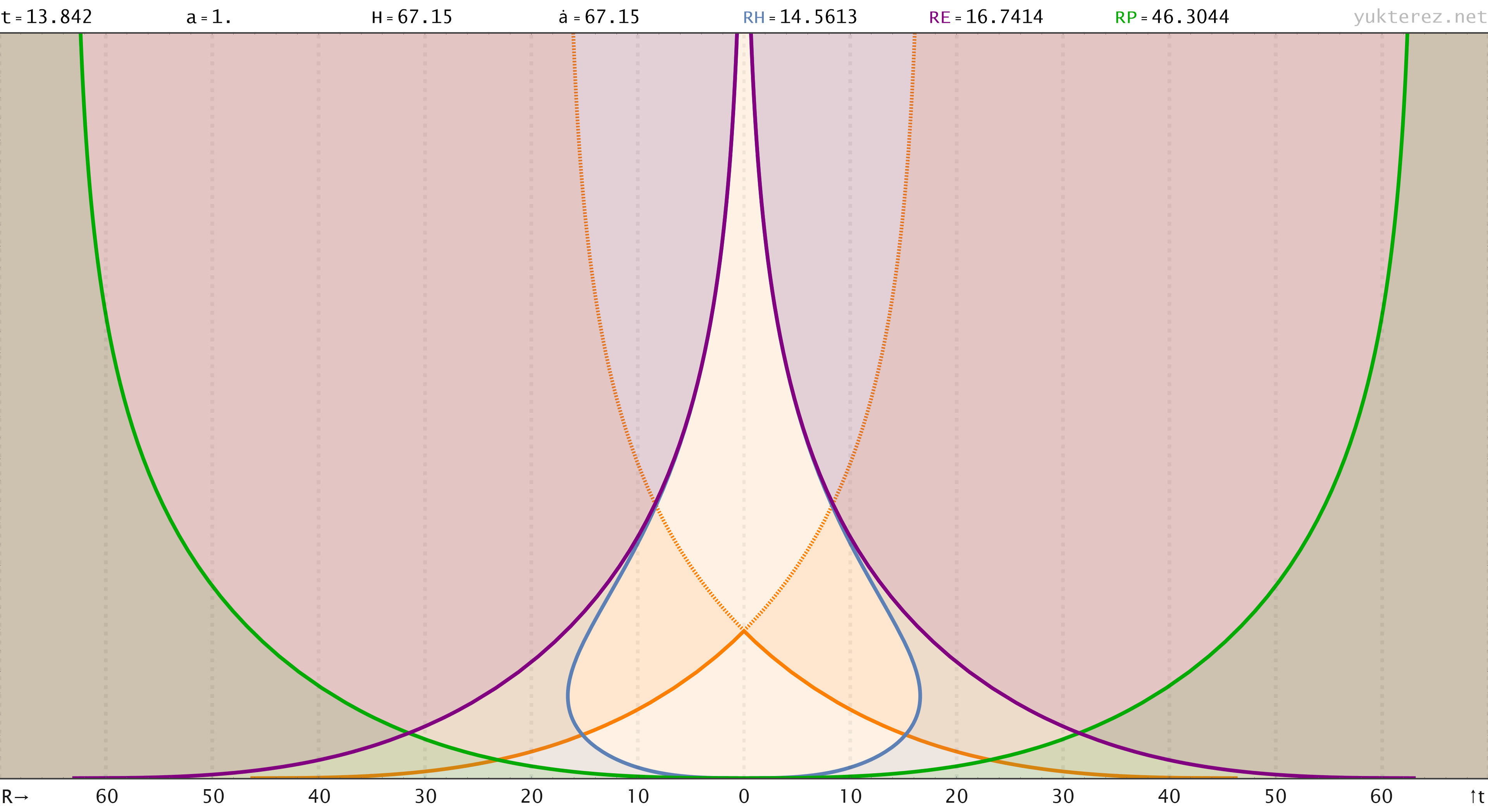
(Same author has an animated version where the light cone moves.)
.gif)
How to read it: horizontal axis is distance (comoving—a ruler that “factors out” expansion), vertical is age of the universe; you sit near the center on the “now” line. Gray dashed lines are galaxy worldlines riding the Hubble flow; orange is the light cone—where light can actually travel.
What the colored lines mean:
- Green (particle horizon): farthest you can see now—boundary of the observable universe.
- Magenta (event horizon): from today, light emitted beyond this never reaches you—the forever-out-of-contact boundary.
- Blue (Hubble radius): where recession speed equals (c); beyond it, stuff can recede faster than light, yet light they sent long ago may still be en route (so blue ≠ “invisible”).
- Orange (light cone): the channel for causal contact.
“The universe expands faster than light” does not mean ships can go FTL—it means distant regions can recede from each other faster than (c). Implication: large parts of the cosmos are already unreachable and permanently out of contact; any intelligence plays on a finite light cone, not the whole universe.
This is a draft, as the title says. I have near-zero formal background in cosmology. These questions still interest me, so I’m posting them prematurely and digging into them interest-driven, bit by bit.
Questions I’m curious about
Given what we know from physics:
1. Does the genesis and evolution of a life-form pass through any necessary events?
Evolution and natural selection, for example. Are self-preservation, replication, game theory, and competition primitives for them? In other words: does cosmic life repeat the same dynamics (variation, replication, selection, games)—or is Earth one freak among many? Is goal discovered, or projected? Can AI terminal goals and biological apparent purpose live in one framework?
2. How should we characterize and classify life in the cosmos? What predictions can we make about distribution and abundance?
3. Cosmic-scale superintelligence (or swarms of it): how far can it go under physical limits?
4. From the above, can we infer the dynamics and goals among cosmic life-forms?
5. If grabby expansion is instrumentally the default, does morality still have an anchor at cosmic scale—or only local games?
6. If heat death (or some other cosmic ending) is true, does anything still mean anything for all life in the universe? Where should longtermism draw its scope—reachable light cone? civilization lifetime? the present experience?
Further reading
- Hanson et al. (2021) Grabby Aliens
- Hanson (1998) The Great Filter
- Lloyd (2000) Ultimate physical limits to computation
- Schrödinger (1944) What is Life?
- Chaisson — cosmic evolution / energy rate density